
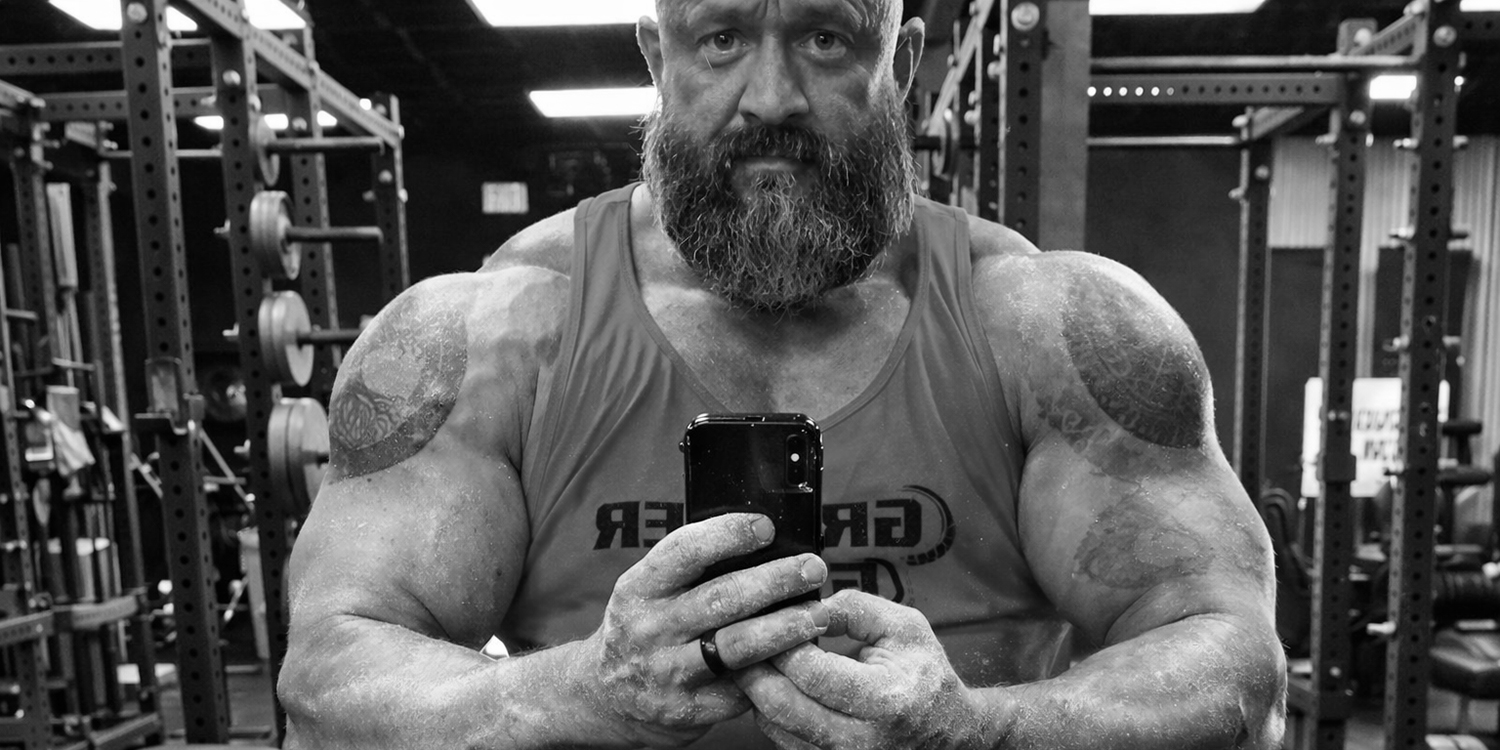
Most people are training for somebody else’s results. You find an athlete you admire, you study what they do, and you build your training around it, like proximity to somebody else’s method is the same as having a plan. It isn’t. What you’re looking at when you watch elite performance is the end of a very long story, filtered through genetics, years of progression, and a level of structural resilience most people just don’t have. You’re not seeing the failures. You’re not seeing the people who tried the exact same thing and disappeared. You’re seeing the one who survived, and mistaking their survival for a blueprint.
That gap between what you see and what actually happened has a name. It’s survivorship bias, and it’s quietly wrecked more training programs than any bad exercise selection ever has.
You’re Following the Wrong Examples
Look at your training program. Really look at it. Then ask one question: where did it come from? Chances are it came from someone who made it. Someone who competed at a high level, put up impressive numbers, and became the example everybody points to. And somewhere along the way you decided that if it worked for them, it could work for you.
That sounds reasonable. It isn’t. You’re seeing one outcome out of thousands, the one that survived. The rest didn’t make the highlight reel. They got hurt, burned out, or just stopped showing up. That’s survivorship bias, and it might be the single biggest reason your training isn’t working.
The Extreme Examples Everyone Points To
You see it everywhere. The Instagram lifter posting daily max-effort sessions. The YouTube coach selling a program built around training like an elite. The TikTok athlete making extreme frequency and intensity look like the baseline, like anything less means you’re not serious. The algorithm rewards the extreme.
But a video of someone grinding through a brutal session isn’t a training log. It’s a highlight reel with no context, no injury history, no recovery data, and no footage of the people who tried the same thing and broke down. The platform is built to show you what performs, not what works. Train harder. Train more often. Push closer to your limit every day. And if it worked for them, it must be the best way to train, right? Wrong. Most people who try that approach don’t end up elite. They end up hurt. Or burned out. Or gone.
Why Some People Thrive Where Most Fail
This is where genetics comes in, and not in a motivational way. In a real, measurable way. There are genetic variations, called SNPs, that influence things like:
- How much muscle you can build
- How fast you recover
- Your fiber type, power versus endurance
- The strength of your connective tissue
- Your risk of injury under heavy load
Some people are built to handle extreme workloads. Most people are not. That’s not an excuse, it’s a fact worth understanding before you design your training. A certain fiber composition might let one athlete train at a frequency that would bury everyone else in fatigue. None of that shows up in the caption. You see the output and assume the input is repeatable.
There’s strong evidence that only a small percentage of people are truly built to tolerate the kind of training you see at the highest levels over the long haul. Everyone else who tries it pays for it eventually, in injuries, in burnout, or in years of spinning their wheels wondering why the results never come. Genetics is the ceiling. Intelligent programming and honest assessment decide how close you get to it.
The Truth Nobody Wants To Say
The people you see at the top didn’t just work harder. They survived what others couldn’t. And because they survived it, they became the example everybody else tries to follow. Sit with what that actually means. The training that produced the champions is also the training that broke a lot of people you never heard about.
So the information that reaches you is skewed by design. Not on purpose, that’s just how selection works. The signal that gets amplified is the one attached to success. Everything else disappears.
This Is Where Most Training Goes Wrong
People assume, this worked for them, so it must be the best way. No. It worked for them because their body could tolerate it, their recovery could support it, and their structure didn’t break under it. That doesn’t make it universal. It makes it selective.
The best training program isn’t the one that produced the best results in the most genetically gifted athlete under ideal conditions. The best training program is the one that produces consistent results in you, given your recovery capacity, your work demands, your sleep, your stress, your injury history, and your actual life. That takes a completely different starting point than copying what you saw online.
What I’ve Learned As a Coach
I’ve always put myself through everything I program, and I’ve trained alongside some of the strongest people in the country. I’ve seen what elite training really looks like up close, not the edited version you see posted, but the real one. The recovery work. The deload weeks. The injuries managed quietly. The years of base-building that made the extreme possible in the first place. What that taught me is simple. The extreme you see is almost never the starting point. It’s the product of a decade or more of intelligent, progressive work that nobody filmed.
Just Because You Can Survive It Doesn’t Mean You Should Program It
I’ve pushed intensity. I’ve tested my limits. I’ve done the kind of training people see online and assume is the standard. And here’s what it taught me: most people don’t need more intensity. They need more consistency. Intensity without consistency gives you a short, impressive peak and then a crash. Consistency without intensity gives you slow, steady progress that compounds over years. The second one wins every time, because you can come back and do it again, month after month, year after year. That takes a different kind of discipline than most people are practicing.
Scientific Principles of Strength Training
A research-backed look at how strength is actually built, and why most programs miss.
View on AmazonAs an Amazon Associate I earn from qualifying purchases.
How I Actually Program
I bias training toward sustainable volume, controlled proximity to failure, and repeatable performance. Most working sets land where you’re getting the stimulus but you’re not destroying your ability to recover. Close to failure. Not buried by it. That means leaving something in the tank, not because the work should be easy, but because the work has to be repeatable. If you come in Tuesday wrecked from Saturday and Monday, you’re not progressing. You’re surviving. And surviving isn’t the same as training.
It also means adjusting to what’s actually happening, not what the spreadsheet says should be happening. Sleep, stress, nutrition, work, all of it feeds into your capacity on any given day. Good programming accounts for that. Rigid adherence to a fixed template doesn’t. Because if you can’t come back and do it again, it didn’t really count.
The Difference Between Programming and Coaching
A program is a set of instructions. Coaching is a conversation. A program tells you what to do. Coaching tells you whether what you’re doing is actually working, and why, and what needs to change today, not next month when you reread your log and wonder where it all went sideways. That real-time feedback loop is what most people are missing, and it’s the difference between years of slow, frustrating progress and a training career that actually builds toward something. You push when it’s there, and you pull back when it’s needed.
The Environment You Train In Matters
At Grinder Gym, you’re surrounded by very strong people, high-level competitors, men and women at the top of multiple strength sports. That’s part of what makes this place special. The energy is real. The standards are high. You can’t fake your way through a session in here, and you won’t want to. But that environment can point you in the wrong direction if you don’t understand what you’re actually looking at. When you watch someone hit a huge lift, that isn’t the standard. It’s the result of years of work you haven’t done yet. And that’s okay, because they were standing right where you are once too.
You’re Seeing the Result, Not the Process
When you see big lifts and high-level performance, it’s easy to think, that’s what I need to be doing. But you’re not seeing the years behind it. The progression it took to get there. The adjustments made along the way. The injuries managed carefully. The stretches of intentionally reduced load. The people who trained just as hard, made all the same choices, and still couldn’t handle it. What you’re seeing is the outcome of a process that took years to build. Trying to skip to the end of that process is how people get hurt, or worse, how they spend years training hard and never actually get better.
Science of Strength Training
The physiology of getting stronger, explained with clear visuals.
View on AmazonAs an Amazon Associate I earn from qualifying purchases.
Why Your Training Has To Be Yours
In an environment like this, it’s easy to do too much, push too hard, and try to match people who are further along than you. That’s exactly why your training has to be specific to you, so you actually get stronger instead of just getting tired. Individual variation is real. The athletes who progress the fastest over a career are almost always the ones who learned early to train within their own biology instead of against it.
We’re Not Just Trying to Make You Strong
We are. But we also want you healthy, still progressing, and here long enough to actually reach your potential. Strength isn’t built in a few months. It’s built over years. The people who reach their full potential are the ones who stayed in the game, who trained intelligently through setbacks, who didn’t blow up their body chasing somebody else’s numbers. They understood the goal is a long career of consistent development, not a short burst of impressive effort followed by an injury that sets everything back.
No One Wins By Burning Out
We don’t want people going all-in for a few weeks and then disappearing. That’s not success. That’s a flameout. And it happens when people try to train above what they can actually recover from. Someone comes in fired up, trains like they’ve got something to prove, ignores the warning signs, and ends up sidelined, sometimes for months. All that progress, stopped cold. And when they come back, if they come back, they’re starting over from a worse spot than where they left. That’s not a training story. That’s a cautionary one.
The Standard at Grinder Gym
The standard here isn’t just strength. It’s sustainable strength, long-term progression, and smart training in a serious environment. Anyone can go hard for a short stretch. That takes nothing but willingness and a tolerance for discomfort. Very few people can stay consistent, stay healthy, and keep getting stronger year after year. That takes something else, a willingness to play the long game when the short game looks more exciting, to do the unglamorous work of building a base while everyone else is chasing peaks. That’s what we’re building here. Not athletes who are impressive for a season. Athletes who are still getting stronger years from now.
Where Do You Go From Here?
Once you understand all of this, you can start training in a way that’s actually built for you. The goal was never to prove how much you can survive. The goal is to progress, stay in the game, and reach your full potential over time. Those are not the same thing. Confusing one for the other is exactly how people end up with years of hard work and very little to show for it.
Be Inspired, Not Destroyed
Here’s what I actually want for you. Hear the call for excellence and answer it. Turn into the fire. Let the heat fuel you. Let the difficulty of hard training, high standards, and serious competition become something you run toward, not something that breaks you down. The pressure that comes with chasing hard things is one of the most valuable experiences you can give yourself. It sharpens your focus, reveals your character, and builds the kind of confidence that only comes from facing something hard and coming out the other side. What it should never become is your destruction.
The athletes you look up to tell you something about the upper limits of human performance. They tell you very little about the specific road you need to take to reach yours. What we’ll undoubtedly share on that road comes down to two things. The first is resilience. You’re going to get knocked down. The question was never whether that happens, it’s whether you get back up. Every athlete who ever achieved something has a story about the moment they almost quit and didn’t. That story doesn’t get told enough, but it’s the one that actually matters.
The second is leading with love. Anger and disdain can light a short fuse, but it burns out. What sustains a long career and a real sense of accomplishment is something quieter and more durable: love for the craft, connection to the people around you, and the honest pursuit of becoming someone you’re proud to be. That’s not soft. That’s the foundation everything else gets built on. Be inspired by what others have done. Be fueled by what you’re capable of. Just make sure the thing driving you forward is building you up, not slowly tearing you apart.
Essentials of Strength Training and Conditioning
The standard text behind strength and conditioning. Dense, but worth it.
View on AmazonAs an Amazon Associate I earn from qualifying purchases.
Get a custom training plan built from our library of 900+ real exercises, matched to your goal, experience, schedule, and equipment. Free, and no signup.
Open the Workout Generator