
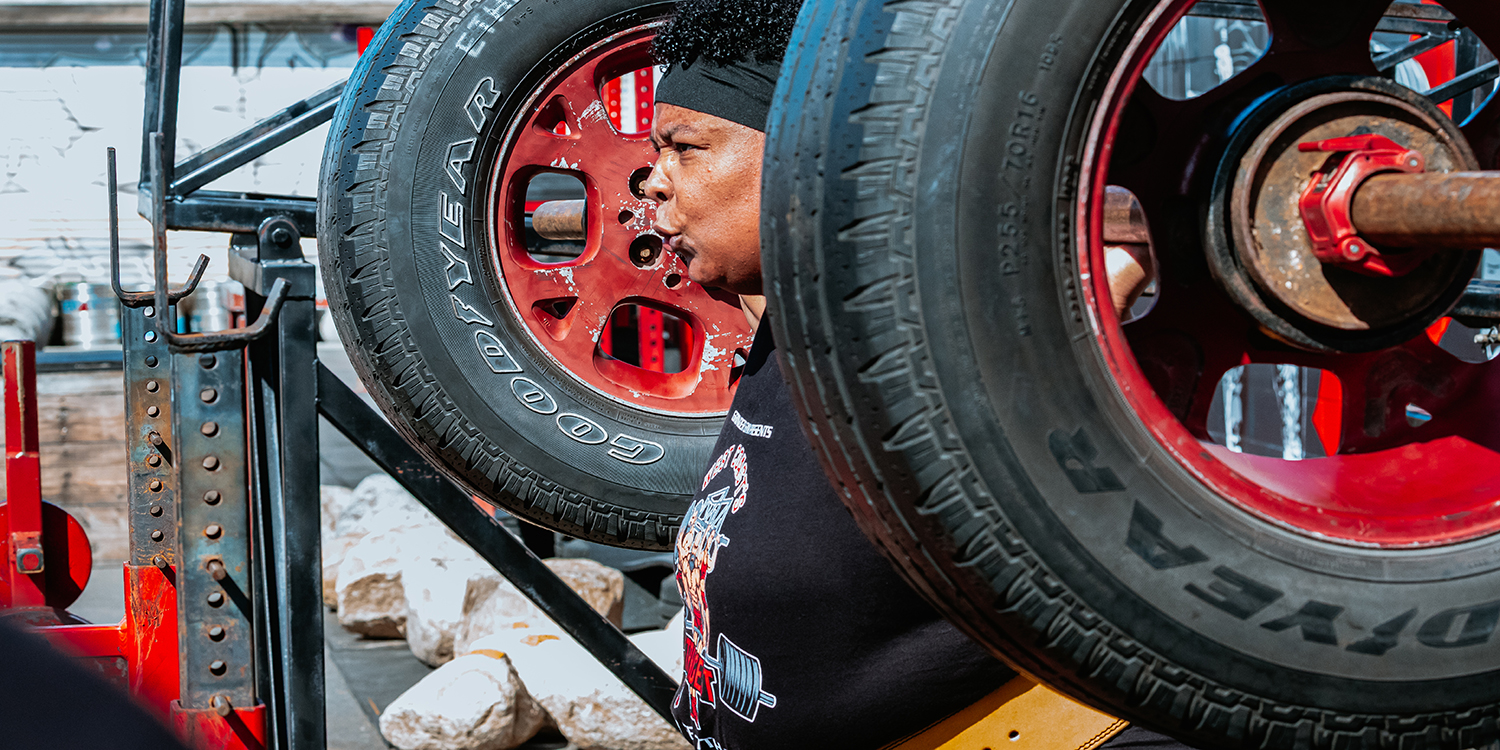
Strongman is unforgiving on recovery. You’re not just hitting a heavy single and going home. You’re often moving awkward, heavy loads for distance or time across multiple events, with grip fatigue, core fatigue, and systemic stress stacking up fast.
Training volume, which is sets times reps times load times frequency, is the variable that separates the athletes who peak on contest day from the ones who burn out, stall, or get hurt along the way. The simplest definition: too much volume is when your recovery fails. When you’re no longer adapting, you’re just accumulating:
- Fatigue
- Nagging injuries
- Performance plateaus
Why Volume Hits Harder in Strongman
Strongman training is different from bodybuilding and even powerlifting. You’re dealing with multiple overlapping stressors:
- Heavy axial loading from yokes and carries
- Grip fatigue from thick handles and long holds
- Bracing fatigue from stones, sandbags, and odd objects
- Nervous-system fatigue from max-effort events
- Conditioning fatigue from medleys and event work
All of that stacks on top of each other, which is why the same volume that builds a powerlifter can bury a strongman.
Signs You’re Doing Too Much Volume
Your body sends signals before it breaks. Watch for these red flags.
Performance Plateau or Drop
- No improvement in weight, distance, time, or reps for 4 to 5 weeks
- Carries slow down
- Loading times increase
- Previous numbers suddenly feel heavier
Persistent Fatigue
- You feel drained even after rest days
- Low motivation to train
- Poor sleep quality
- Irritability or low energy outside the gym
Joint Pain or Overuse Issues
- Elbows constantly irritated
- Shoulders or knees aching
- Lower-back tightness lingering
- Grip fatigue lasting 3+ days after heavy sessions
Additional Warning Signs
- Frequent deloads needed every few weeks
- Grip giving out early in sessions
- Loss of appetite
- Mood swings
- Feeling broken instead of trained
If two or three of these show up at the same time, your training volume is probably too high.
How Much Volume Is Actually Optimal?
Strongman isn’t built on traditional high-volume hypertrophy work. A typical hypertrophy model might use 10 to 20 sets per muscle group per week. Strongman uses less repetition than that, because the recovery windows between contests can be short. Quality exposure beats endless volume.
Practical Volume Guidelines by Experience Level
Beginner / Novice
(0 to 12 months of strongman-specific training.) A typical weekly structure:
- 2 to 3 strongman sessions per week
- 1 to 2 heavy barbell strength days
- Event work: 1 to 2 events per session
- Accessories: 3 to 4 movements (grip, trunk, upper back)
- Total lower-body loading: 2 to 3 sessions weekly
The goal here is to build tolerance, learn technique, and develop durability. Not exhaustion.
Intermediate
(1 to 3 years, novice or open competitor.) A typical weekly structure:
- 3 to 4 training sessions per week
- 1 to 2 heavy strength days
- Event work: 2 to 4 events per session
- Conditioning: 1 to 2 targeted sessions
- Accessories: focused on your weak points
The goal is to increase your event exposure, improve your strength expression, and manage recovery carefully.
Advanced / Competitive
(Open level, multiple contests.) A typical weekly structure:
- 3 to 5 total sessions per week (often 4)
- Heavy event blocks rotated every 2 to 3 weeks
- Peaking phases that avoid burnout before competition day
Balancing Volume Without Burning Out
Strongman progress comes from managing stress, not constantly adding more.
Prioritize Recovery
- Sleep 7 to 9 hours
- Eat enough calories and protein
- Manage your life stress outside the gym
Limit True Max Effort
One to two max-style exposures per week is plenty. Anything more usually just reduces your recovery quality.
Rotate Intensity
Cycle it: a heavy week, then a speed and technique week, then a moderate week. Your intensity should fluctuate, not climb constantly.
Autoregulate
If your grip is fried, your back is tight, or your energy is low, adjust the session. Technique work beats forcing heavy loads on a bad day.
Deload Regularly
Every 4 to 6 weeks, drop your volume 40 to 60%, reduce the loading, and focus on movement quality. Deloads keep fatigue from turning into injury.
Monitor Grip and CNS
Grip recovery is one of the clearest indicators of fatigue. If your grip is still gone 48 to 72 hours later, your training volume is probably too high.
The Volume Trap Most Athletes Fall Into
The most common mistake looks like this:
- Heavy barbell training
- Add event training
- Add conditioning
- Add grip work
- Repeat with no real recovery
Instead, rotate your emphasis week to week:
- Strength-emphasis weeks
- Event-emphasis weeks
- Conditioning-emphasis weeks
- Recovery or technique weeks
Progress comes from fluctuation, not accumulation.
How We Manage Volume at Grinder Gym
At Grinder Gym, we don’t chase exhaustion. We chase adaptation. Programs are built around:
- The athlete’s recovery capacity
- The contest calendar
- Experience level
- Current weak points
Typical structures: beginners run 2 to 3 sessions per week with controlled accessory work; intermediates run 3 to 4 sessions with targeted conditioning; competitors run structured event blocks with strategic tapering phases. And we monitor constantly:
- Grip recovery
- Sleep and energy
- Joint health
- Event performance trends
If the volume is too high, we reduce it. No ego involved. Because strongman rewards the athletes who can sustain progress, not just survive brutal training weeks.
The Bottom Line
Strongman isn’t about doing the most work. It’s about doing the right work and recovering from it. More volume isn’t always better. Smart volume wins contests. Enough to adapt. Not so much that you break.
Tactical Strongman: The Complete Guide
A full guide to strongman training and competition.
View on AmazonAs an Amazon Associate I earn from qualifying purchases.
Get a custom training plan built from our library of 900+ real exercises, matched to your goal, experience, schedule, and equipment. Free, and no signup.
Open the Workout Generator