
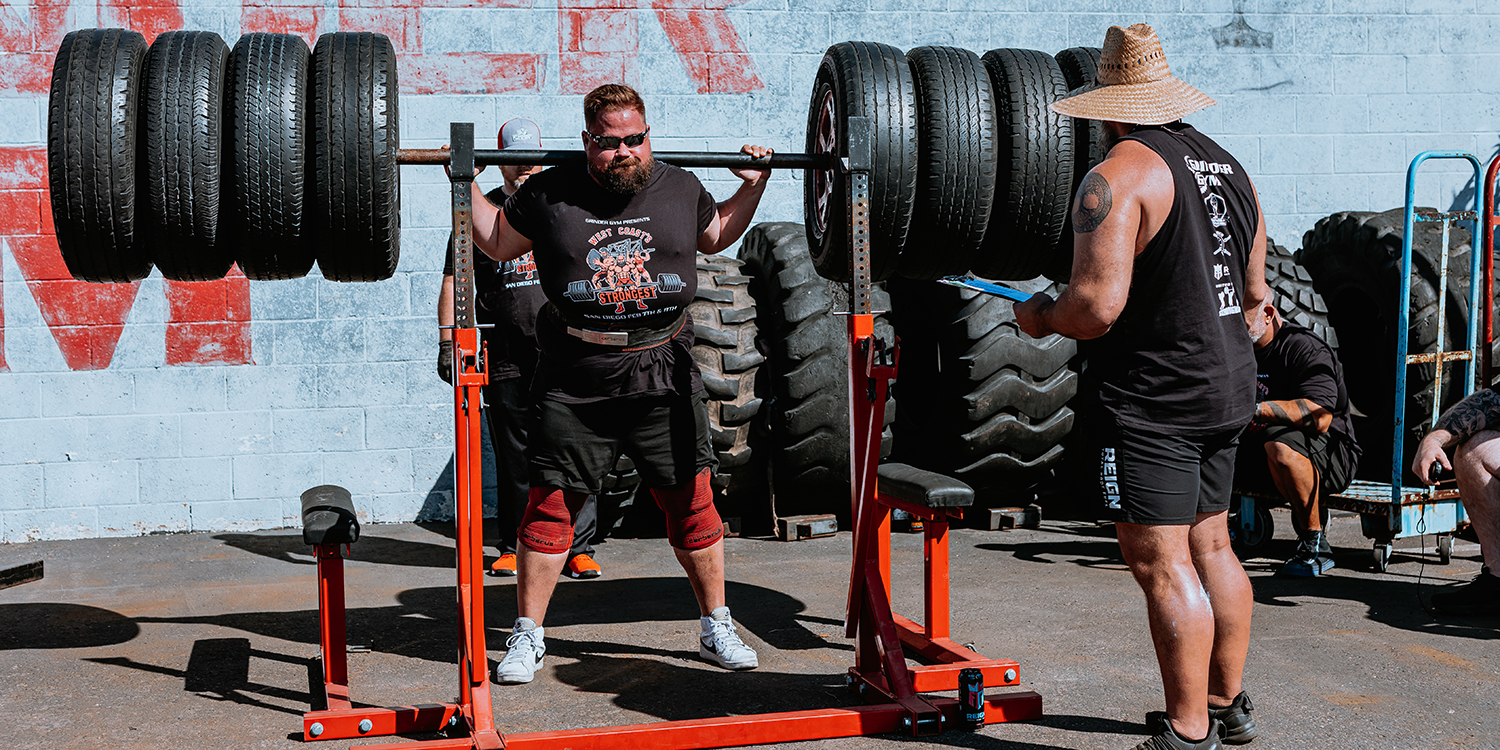
Once you decide to compete, coaching changes gears. It stops being about general strength and starts being about getting you ready to perform on a specific day. The training gets pointed. Every session is built around what contest day actually demands of you: the events, the pacing, the conditioning, and the headspace it takes to show up and deliver when it counts. Good coaching gives you the structure to prepare on purpose instead of hoping you’re ready once you get there.
Event Breakdown and Strategy
No two strongman contests are the same. The implements, the heights, the distances, the time limits, all of it shapes how you should attack a given event. A coach breaks each one down and builds you an actual plan: how to set up the pick, where to save energy, and when to empty the tank. You stop walking up to an event guessing and start walking up to it with a plan you’ve already rehearsed.
Pacing Across Multiple Events
Strongman isn’t one lift, it’s a string of efforts stacked on top of each other. You’ve got to manage fatigue across several events, usually with not much recovery in between. Coaching teaches you how to pace, how to spend your energy, and how to keep your performance from falling apart between the first event and the last. This is the part where preparation separates from raw strength. The strongest athlete in the room doesn’t always win. The best-prepared one usually does.
Strength and Conditioning Progression
Being ready to compete takes both sides of the coin. Strength training builds your capacity to handle the loads. Conditioning makes sure you can repeat efforts, recover quickly, and hold your output together when fatigue sets in. Your programming has to balance the two and bring you to a peak at the right time. None of that gets crammed in at the end. Real preparation is phased out over weeks, not rushed in the final stretch.
Weight Class Planning
For a lot of athletes, competing means managing bodyweight too. Coaching helps you plan out any weight changes, your nutrition, and the timing of all of it so you step on the platform strong, recovered, and inside your class. The whole point is to support your performance, not to gut it making weight. Smart planning protects the strength you worked so hard to build. I’ve seen too many lifters leave their best on the scale instead of the platform.
Mental Preparation
Competition demands composure. You’re performing under pressure, adjusting to conditions you can’t control, and trying to stay locked in through mistakes, delays, and plain old fatigue. Coaching builds the routines and the confidence that keep you present in each event instead of getting rattled. Your head doesn’t replace your strength, but when it’s right, it’s what lets you actually use the strength you brought.
From Training to Performance
This is where structured coaching earns its keep. It connects all that preparation to what you actually do on contest day. By the time you compete, you should know:
- How to approach each event
- How to manage your effort across the day
- How to adapt if conditions change
- How to perform with confidence
When the training is built right, it ties directly to the result. You’re not hoping it carries over. You’ve been rehearsing the day the whole time.
BUILT BY MIKE 2.0: Proven Programming for the Strongman Athlete
Structured programming written for the strongman athlete. Worth a look if you are preparing to compete.
View on AmazonAs an Amazon Associate I earn from qualifying purchases.
Get a custom training plan built from our library of 900+ real exercises, matched to your goal, experience, schedule, and equipment. Free, and no signup.
Open the Workout Generator