Description:
Suspended rows are a bodyweight exercise that targets the muscles of the back, including the latissimus dorsi, rhomboids, and trapezius. This exercise uses suspension straps to leverage your own body weight as resistance.
Benefits:
Suspended rows help to improve upper back strength, stability, and muscle endurance. They also engage the biceps and core, making it a comprehensive upper body exercise.
Profile:
| Equipment: | Suspension Straps |
| Type: | Bodyweight |
| Tempo: | 2-1-2-0 |
| Level: | Intermediate |
Muscles:
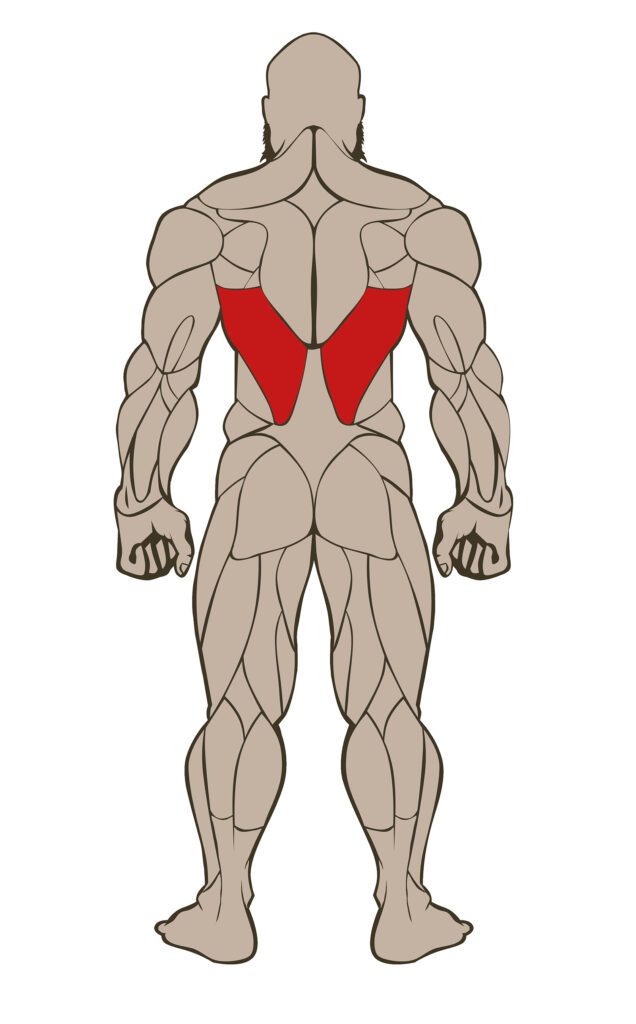
Primary Muscles
- Latissimus Dorsi
Secondary Muscles
- Rhomboids
- Trapezius
- Biceps
- Core
Classification:
| Utility: | Basic |
| Mechanics: | Compound |
| Force: | Pull |
Instructions:
- Step 1: Attach suspension straps to a secure anchor point.
- Step 2: Hold the handles and lean back with your feet planted on the ground, creating a straight line from head to heels.
- Step 3: Keep your body straight and engage your core.
- Step 4: Pull your chest towards the handles by bending your elbows and squeezing your shoulder blades together.
- Step 5: Slowly return to the starting position.
- Repeat the movement for the desired repetitions.
Common Mistakes:
- Rounding the lower back
- Using momentum to pull the straps
- Allowing the elbows to flare out
- To avoid these mistakes, keep your core engaged, maintain a neutral spine, and use a controlled motion throughout the exercise.
Variations:
- Single-arm Suspended Rows
- Feet-elevated Suspended Rows
- Suspended Row with Rotation
- Suspended Face Pulls
Links to each will be provided as they are added to the website.
Safety Tips:
- Always perform a proper warm-up before doing suspended rows.
- Start with a higher anchor point if you are a beginner and progress to a lower one as you build strength.
- If you have any pain or discomfort, stop the exercise and speak with a trainer.
Additional Information:
Suspended rows are a versatile and effective way to build back strength and improve posture. They engage multiple muscle groups and can be adjusted for difficulty, making them suitable for all fitness levels.
EXERCISES