
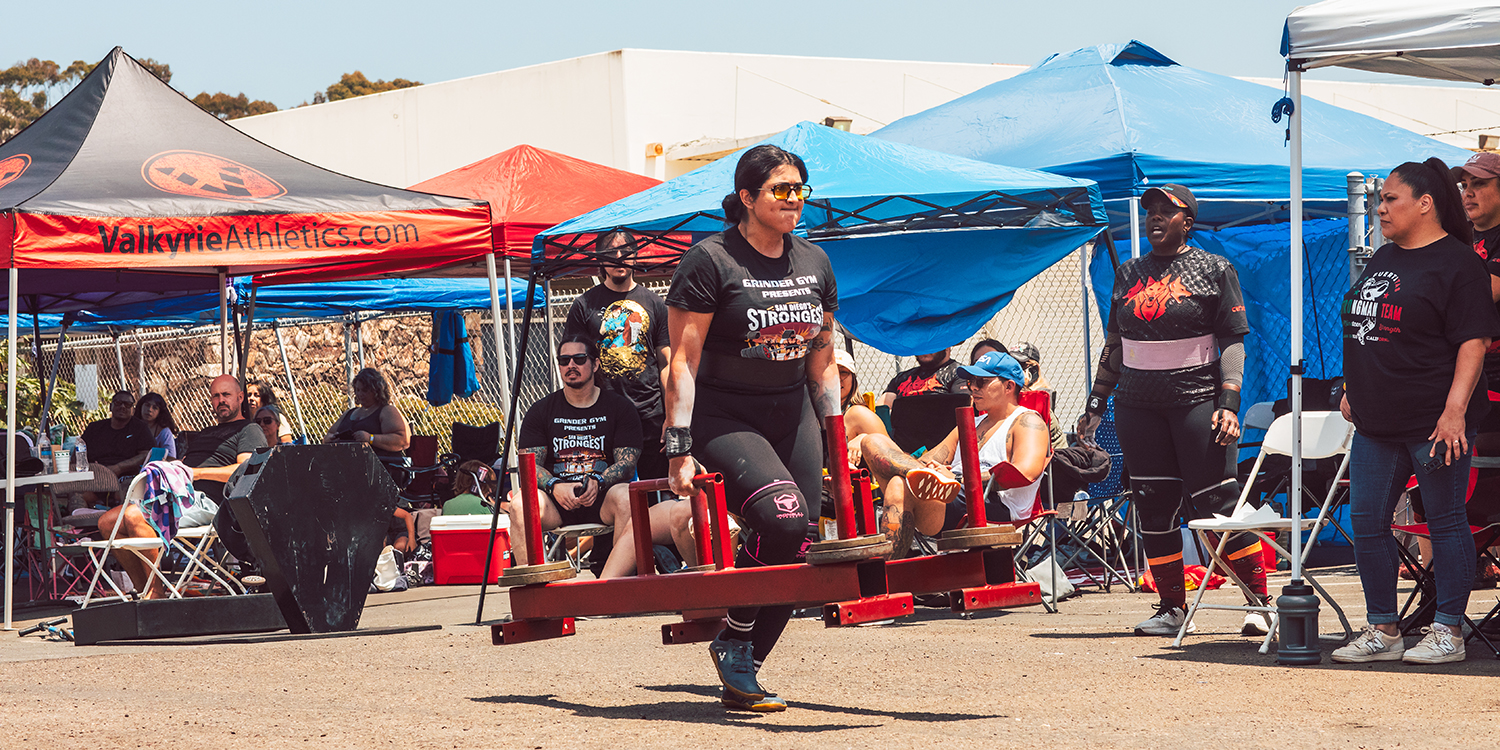
The farmer’s walk is one of the most straightforward yet brutally effective events in strongman. Pick up heavy handles and move. That’s it. But execution separates the top finishers from everyone else. Grip fails. The core softens. Shoulders round. Pace drops. And seconds or meters lost in the middle of a run decide placings. At Grinder Gym, we treat the farmer’s walk as a full-body skill. It improves dramatically with deliberate technique, not just heavier handles. Here’s how to build an unbreakable grip, hold your speed, and carry farther under competition loads.
The Pick Sets the Entire Run
The first mistake most athletes make is rushing the pick. Treat it like a deadlift setup:
- Feet under hips
- Handles tight to the body
- Chest high
- Lats locked down
- Core braced before the lift
Stand up with control. Stabilize. Then move. If you start walking before you’re organized, the implements swing, your grip burns out early, and the run falls apart before it even begins.
Grip Setup and Hand Position
Your grip is the run. Set it up right:
- Use a full, aggressive grip if the handles allow
- Squeeze hard before the pick to preload tension
- Keep your wrists neutral, not bent back
- Shrug into the traps before lifting to create a stable shelf
- Once loaded, pull your shoulders down and back to stay packed
Think about crushing the handles and slightly pulling them inward to engage your upper back. Drill: static farmer’s holds for 15 to 30 seconds at contest weight. No walking. Just grip and posture.
Bracing and Trunk Rigidity
Farmer’s walks punish soft cores. Every step creates rotational and lateral force, and your trunk has to stay locked in.
- Take a massive diaphragmatic breath before the pick
- Brace 360 degrees: abs, obliques, lats, lower back
- Ribs down, pelvis neutral
- Compress the space between your ribs and hips
Think “short torso, strong column.” Drill: pick, take 3 to 5 steps, stop, and reset the brace. Repeat until that tension becomes automatic.
Shoulder and Upper Back Positioning
Your posture determines how long your grip lasts.
- Pre-shrug hard into the handles before lifting
- Once moving, keep your shoulders packed down and back
- Head neutral, eyes forward
- Actively create tension through the lats
If your posture collapses, your grip goes with it.
Footwork and Stride Mechanics
Speed comes from your stride, not from muscling the load.
- Feet landing under your hips
- Minimal vertical bounce
- A slight forward lean from the ankles
Long strides create sway. Short steps keep the implements stable and let speed build. Drill: use a metronome at 180 to 200 BPM for unloaded or light carries to groove fast turnover.
Breathing and Tension Maintenance
Breathing under heavy carries is a skill of its own.
- Take a huge breath before the pick and hold it as long as possible
- If your tension drops, exhale slightly and immediately re-brace
- Never dump all your air under load
- Use short, controlled exhales to maintain pressure
Lose pressure, lose posture. Lose posture, lose grip.
Acceleration and Speed Strategy
Most farmer’s events reward speed over max strength. After the pick:
- Stabilize
- Take a few controlled steps
- Build speed progressively
Don’t explode into a sprint right away. That creates sway and wastes energy. Maintain your rhythm, build your speed, and finish past the line every time.
Control the Swing
Even with a perfect setup, the implements will try to drift. Your job is to eliminate that movement.
- Keep the handles tight to your sides
- Maintain lat tension
- Move with a consistent stride rhythm
When one side swings, your grip fatigue doubles and your speed disappears.
Accessory Work to Build Farmer’s Strength and Grip
Farmer’s success depends on:
- Grip endurance
- Trap and upper-back density
- Core stability
- Single-leg strength
- Leg drive under load
A strong support structure keeps your posture intact when the fatigue hits.
Sample Farmer’s-Focused Session
- Farmer’s Carries: 3 to 5 sets of 50 ft, alternating heavy slow runs and lighter speed runs week to week; track your times and distances
- Frame or Trap Bar Deadlifts: 4 to 5 sets of 6 to 8, focused on speed off the floor
- Bulgarian Split Squats: 3 to 4 sets of 10 per leg
- SS Yoke Bar Shrugs: 3 to 4 sets of 10 to 12, heavy and controlled
- Thick-Bar Holds: 3 to 4 sets for max time
- Ab Wheel Rollouts: 3 to 4 sets of 12 to 15
Why This Works
Grip-specific accessories prevent hold failures. Upper-back and trunk work maintains your posture under fatigue. Single-leg strength improves your balance and prevents side-to-side collapse. And rotating heavy and speed work builds both power and endurance.
Programming Farmer’s Walks
Farmer’s walks should be trained across intensities:
- Heavy short runs for structure
- Moderate runs for speed
- Lighter, longer runs for conditioning
Progress by:
- Increasing the load
- Increasing the distance
- Improving your time
- Improving your stability
Heavy every session burns athletes out. Rotation builds performance.
How We Train Farmer’s Walk at Grinder Gym
We don’t just load the handles and say go. We build mastery:
- Start light to groove the grip, brace, and footwork
- Progress to loaded carries for distance and time
- Add static holds and heavy partials
- Simulate competition transitions, farmer’s into the next event
- Coach breathing, posture, and speed in real time
Because in competition, the farmer’s never happens in isolation. Fatigue stacks. Pressure builds. Execution matters.