
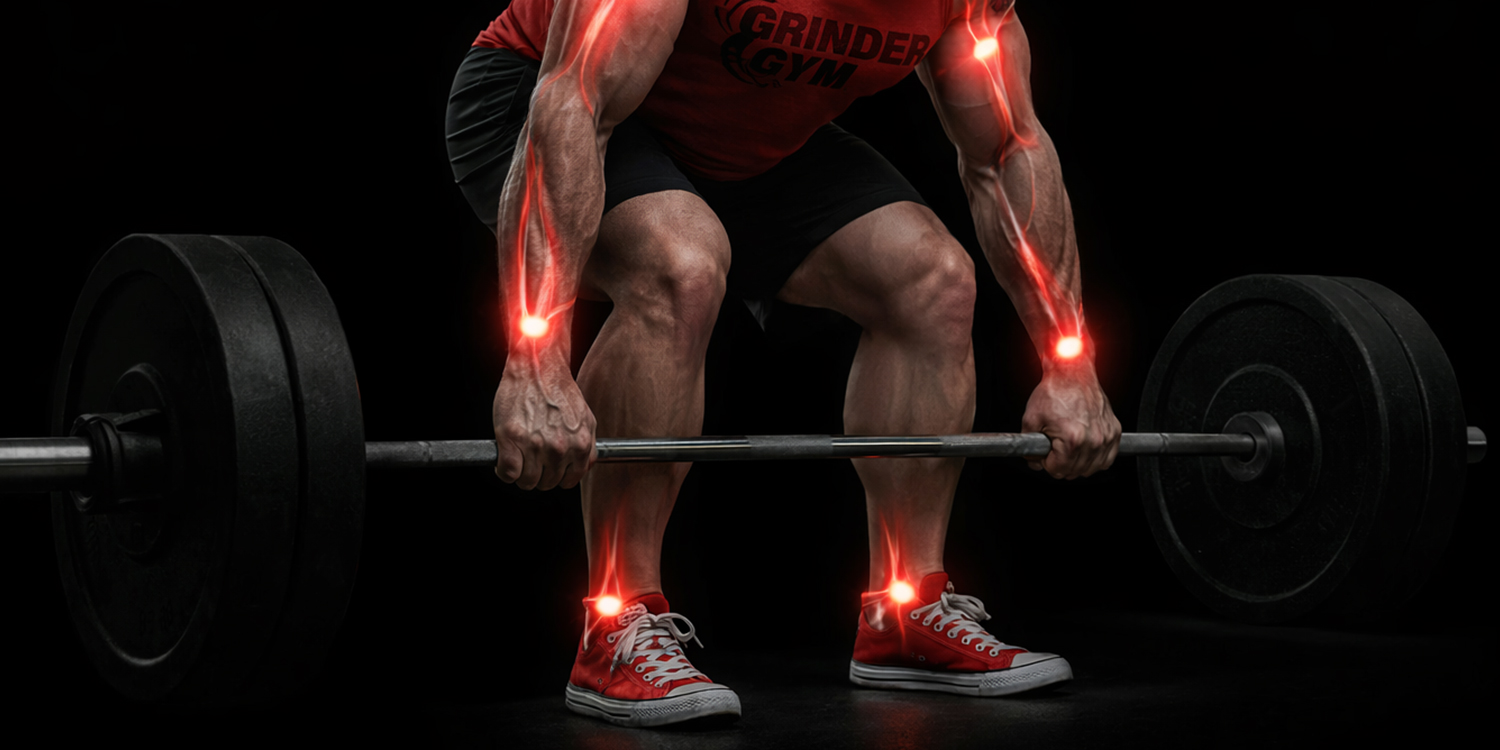
Muscles move the weight, but your connective tissue determines whether your body can actually handle it. Every lifter eventually hits a point where their muscles can produce more force than their joints, tendons, and ligaments can safely tolerate. When that happens, progress slows. The nervous system starts holding back force production, joints start to ache, and lifts that used to feel solid suddenly feel unstable.
This is one of the most misunderstood limitations in strength training. Most lifters think they need more muscle, more volume, or heavier weight. In reality, a lot of plateaus happen because the connective-tissue structures supporting the lift haven’t caught up to the strength of the muscle. Tendons, ligaments, fascia, and joint capsules adapt more slowly than muscle does. They need specific kinds of loading and enough time to remodel and strengthen. The whole purpose of a connective-tissue strength workout is to reinforce the structural framework so your body can handle heavy training for years.
The Structural Strength Principle
Strength is limited by the weakest structure involved in the lift. If the muscles around a joint can produce more force than the tendons and ligaments can tolerate, the body restricts the output as a protective mechanism. The nervous system does that automatically to prevent structural damage. It’s why lifters so often run into problems like:
- Elbow pain during pressing movements
- Knee irritation under heavy squats
- Shoulder discomfort when benching or pressing overhead
- Tendon soreness that shows up before the muscles even feel fatigued
These aren’t random injuries. They’re signals that the connective tissue supporting the movement is underprepared for the load you’re putting on it. When that connective tissue gets stronger and more resilient, the nervous system gets more confident and allows higher force output. The result is better performance and lower injury risk.
Why Connective Tissue Requires Different Training
Muscle adapts quickly to a training stimulus. Connective tissue adapts slowly. Muscle fibers respond to mechanical tension, metabolic stress, and training volume, and in a lot of cases you can see measurable growth within weeks. Tendons and ligaments adapt mainly through mechanical loading over time. Their remodeling involves collagen synthesis, cross-linking of fibers, and gradual increases in stiffness and tensile strength. Because they adapt more slowly, they respond best to methods that include:
- Moderate loading
- Controlled movement speeds
- Longer time under tension
- Isometric contractions
- Gradual exposure to heavier loads
These strategies let connective tissue take on meaningful stress without overwhelming the joints. When lifters jack up the load too fast without letting connective tissue adapt, they run straight into the exact limitations that stall progress. So training connective tissue is really about loading it a different way, one that lets the body adapt without excessive strain.
Five Methods for Building Connective Tissue Strength
There are five training methods that build connective tissue effectively. Each one loads the tissue in a slightly different way.
Isometric Strength Work
Isometric contractions produce force without joint movement. Because the joint stays still, the tendons experience high levels of tension while the joint structures stay relatively stable. That makes isometrics extremely valuable for connective-tissue development, because holding a position under load lets the tendons adapt to sustained force while minimizing wear on the joint surfaces. Effective examples:
- Isometric mid-thigh pulls
- Wall sits
- Split squat holds
- Plank variations
- Bench press holds at sticking points
Isometric training is especially good for strengthening the connective tissue around the knees, shoulders, and elbows, which take a beating during heavy lifting.
Slow Eccentric Training
Eccentric contractions happen when a muscle lengthens while it’s under tension, and during that phase the connective tissues experience significant mechanical loading. Slowing the eccentric down increases the time they spend under that load. Effective examples:
- Squats with a slow lowering phase
- Romanian deadlifts performed under control
- Slow eccentric dips
- Controlled bench press negatives
Eccentric training also improves your movement control, which helps you hold stable joint positions under load.
Structural Partial Range Training
Partial-range movements let you train heavier loads inside your mechanically strongest positions. Instead of moving through the full range of motion, you focus on the positions where the joint structure is best aligned to handle force. That exposes the connective tissue to higher loading without piling stress onto vulnerable joint angles. Examples:
- Rack pulls
- Pin presses
- Quarter squats
- Board presses
- Top-range carries
These movements let the body gradually increase its connective-tissue tolerance to heavier loads.
Tempo and Time-Under-Tension Training
Extending the time a joint spends under tension is another effective way to stimulate connective-tissue adaptation. Examples:
- Pausing briefly at the bottom of a lift
- Controlled pressing speeds
- Slow lunges and step-ups
This approach also improves your movement awareness and reinforces proper joint positioning.
Loaded Carry Training
Few exercises strengthen connective tissue throughout the entire body as effectively as loaded carries. Carrying heavy objects forces your joints, tendons, and stabilizing muscles to work together to hold structural integrity under load. Loaded carries develop:
- Joint stability
- Tendon stiffness
- Core rigidity
- Grip strength
- Whole-body coordination
Some carry variations to use:
- Farmer’s carries
- Sandbag carries
- Zercher carries
- Yoke walks
- Suitcase carries
Strongman athletes have used loaded carries as a cornerstone of their training for a long time, because they reinforce exactly the structural strength you need for handling heavy loads.
Example Connective Tissue Strength Workout
This session is designed to reinforce connective-tissue strength without interfering with your primary strength training sessions.
Connective Tissue Strength Session
- Isometric Split Squat Hold: 3 sets of 20 to 30 seconds per leg
- Tempo Squats (3-second descent): 4 sets of 6 repetitions
- Slow Eccentric Chin-Ups: 4 sets of 5 repetitions with a 5-second lowering phase
- Pin Press (mid-range): 4 sets of 5 repetitions
- Farmer’s Carry: 4 sets of 40 to 60 feet
- Reverse Sled Drag: 4 sets of 60 feet
This workout targets the connective-tissue structures around your knees, hips, shoulders, and elbows while reinforcing your overall structural stability.
How This Fits Into Hypertrophy-Centric Cyclical Training
Inside Hypertrophy-Centric Cyclical Training, connective-tissue development happens primarily during the Structural Hypertrophy phase. That phase emphasizes building muscle mass while reinforcing the structural systems that support strength. The training there focuses on:
- Increasing muscle cross-sectional area
- Improving tendon resilience
- Reinforcing joint stability
- Preparing the body for heavier loading phases later in the cycle
Without that structural base, lifters often struggle when they transition into high-intensity strength phases. Building muscle without reinforcing connective tissue is like adding horsepower to an engine without strengthening the transmission that has to transfer that power.
Signs Your Connective Tissue Needs More Training
A lot of lifters ignore connective-tissue development until discomfort forces them to deal with it. Common warning signs:
- Elbows that ache during pressing movements
- Knees that feel unstable under heavy squats
- Shoulder irritation during overhead lifting
- Tendon soreness that lingers longer than muscle fatigue
These signals tell you that your connective-tissue adaptation has fallen behind your muscular strength. Addressed early, structural training can restore stability and let your progress continue.
Strength That Lasts is Structural
The strongest athletes in the world share a common trait: their bodies are structurally prepared to handle heavy loading. They’ve developed tendons that transmit force efficiently, joints that stay stable under stress, and connective tissue that reinforces every movement they make. Muscle may create strength, but the structure determines whether that strength can be expressed safely. Strength built on muscle alone is temporary. Strength built on structural integrity lasts.
Conclusion
Real strength isn’t simply the ability to lift heavy weight once. It’s the ability to lift heavy weight repeatedly, safely, and consistently over years of training. When you train your connective tissue, your body becomes capable of expressing greater force. So train connective tissue deliberately. Build the structure first. Then let strength follow.
Science and Practice of Strength Training
A classic reference on the science and programming behind strength.
View on AmazonAs an Amazon Associate I earn from qualifying purchases.
Get a custom training plan built from our library of 900+ real exercises, matched to your goal, experience, schedule, and equipment. Free, and no signup.
Open the Workout Generator