
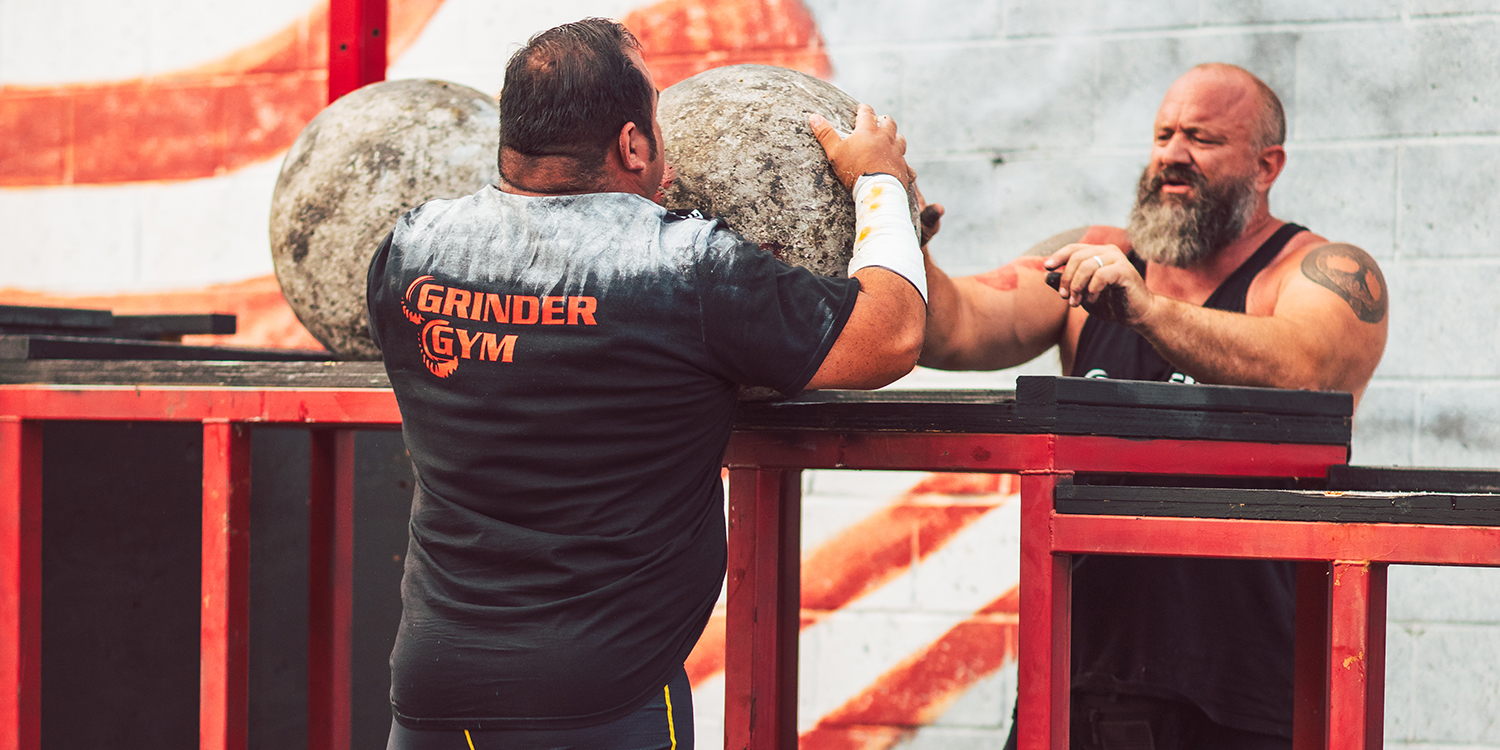
Stone loading is one of the most iconic and technically demanding events in strongman.
On the surface, it looks simple. Pick up a round, heavy, uncooperative object and load it onto a platform.
In reality, it is a full-body explosive movement that tests hip extension, trunk rigidity, grip, lap strength, timing, and composure under max strain. Inefficient technique wastes energy, costs seconds, and leads to missed loads. Efficient technique turns a 300-pound stone into something you can move repeatedly and confidently.
At Grinder Gym, we treat stone loading as a skill first and a strength test second. Strength helps, but efficiency is what wins series and finishes contests.
Here is how to increase both efficiency and power so you can load faster, cleaner, and more consistently.
Stone Loading Happens in Phases
Stone loading is not one motion. It is three phases that must work together.
The pick
The lap
The load
Each phase has its own demands and its own technical standards.
1. Master the Setup and Initial Pick
The first few inches off the ground determine the entire lift.
Key cues:
Feet hip-width, toes slightly out, shins close to the stone
Grip low with fingers under the stone if possible
Big diaphragmatic breath and hard brace before moving
Hips set like a deadlift, chest tall, back tight
Pull the stone into you while driving hips forward
Do not try to lift the stone with your arms. The pick is driven by legs, hips, and lats. If the stone drifts away from your body, it instantly becomes heavier and harder to control.
Common mistake
Rounding the back and trying to arm-curl the stone.
Fix
Use lighter stones or blocks and drill the initial pull with focus on hip drive and lat tension.
2. Lap the Stone Efficiently
The lap is the make-or-break moment.
It is not a rest. It is a reset and repositioning phase where power is built.
As the stone rises:
Sit back slightly and catch it high on the thighs
Keep elbows high and out like a front squat rack
Pull the stone tight into your torso
Reset your breath and brace again
A poor lap drains energy and leads to failed loads. A controlled lap sets up an explosive finish.
Drill
Stone-to-lap only for repeated reps. Focus on speed into position and tightness.
3. Transition to the Platform: The Dip and Drive
This is where loads are won or lost.
From the lap:
Take a small, quick dip
Explode upward with hips and legs
Shrug and roll the stone onto the platform
Keep the core braced and avoid leaning back
The dip is not a squat. It is a fast bounce that creates momentum.
Cue
Explode and extend.
The stone should roll, not float.
4. Grip and Hand Positioning
Grip fatigue ends more stone series than strength.
Best practices:
Use a low fingertip grip for leverage
Chalk heavily and often
Train grip separately with thick bars, pinches, and holds
Build endurance with repeated lighter loads
The tighter the stone stays to your body, the less your grip has to fight.
5. Breathing and Bracing Under Load
Stone loading demands aggressive bracing.
Before the pick
Take a huge breath and brace hard
During the lap
Reset quickly if needed
During the load
Maintain tension and drive through the hips
If you lose your brace, you lose your power.
Drill
Static stone holds in the lap position for 10 to 20 seconds focusing only on breathing and tension.
6. Speed and Efficiency Training
Most contests involve multiple stones, increasing weights, and time pressure.
Efficiency under fatigue wins.
Train:
Timed loads from floor to platform
Speed sets with lighter stones
Stone to carry transitions
Stone to shoulder and stone over bar for explosive development
The goal is to move automatically when tired.
Accessory Work That Builds Stone Power
Stone loading is built on posterior chain strength, lap strength, and trunk rigidity.
Key movements:
Block pulls and rack pulls for top-end strength
Front squats and Zercher squats for lap position power
Hip thrusts and glute-ham raises for extension
Ab wheel and hanging leg raises for bracing
Farmer’s carries for grip and trunk control
Stones reward athletes who can extend violently and stay tight.
Sample Stone-Focused Session
Stone loads
4 to 6 reps at challenging effort, time each run
Block pulls
3 sets of 5 heavy
Pause front squats
3 sets of 5 with a two-second pause
Ab wheel rollouts
3 sets of 12 to 15
Farmer’s carries
3 runs of 40 to 60 feet
This structure builds strength, speed, and repeatability.
How We Train Stone Loading at Grinder Gym
We do not just throw athletes at heavy stones and hope.
We build the skill progressively:
Lighter stones or blocks to groove mechanics
Focused lap and transition drills
Coached breathing and bracing
Timed series under fatigue
Competition simulations with immediate follow-up events
Efficiency is always prioritized before loading heavier.
Because on contest day, hesitation costs seconds and seconds decide placings.
The Bottom Line
Stone loading is not about brute strength alone.
It is about:
Tight positioning
Explosive hips
Efficient transitions
Grip endurance
Mental commitment
The strongest athlete is not always the best stone loader. The most efficient one usually is.
If you want to load stones faster, cleaner, and more consistently, hands-on coaching makes the difference.
Register for an upcoming Strongman Workshop at Grinder Gym and learn:
Proper setup and lap mechanics
Explosive hip drive and transition timing
Grip and bracing strategies
Full event simulation training
Stone loading is not about being the strongest person in the room.
It is about being the most efficient when the stone fights back.
Let’s make loading feel automatic and powerful when it counts.
Comments are closed