
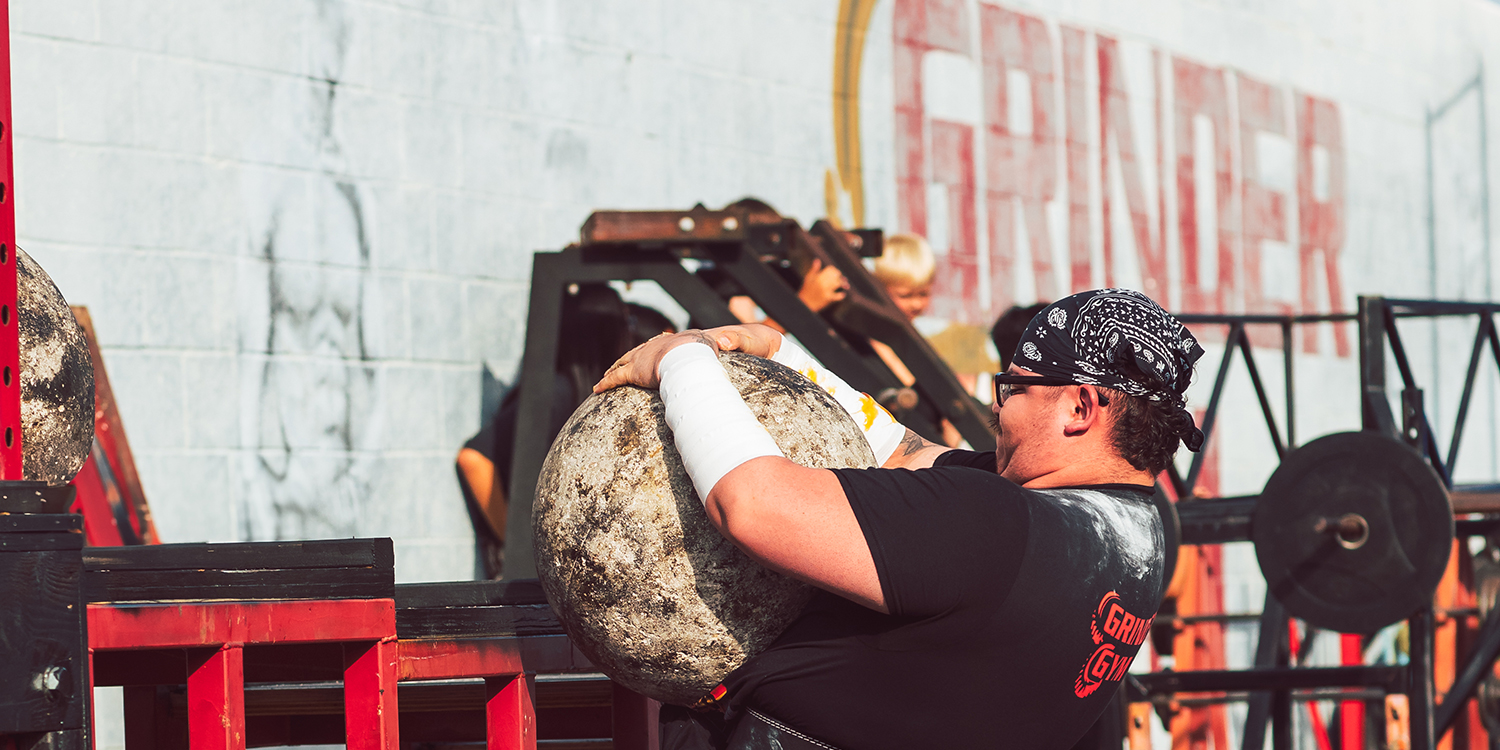
Strongman is as much a mental sport as it is a physical one.
Raw strength might get you to the start line, but mental toughness is what carries you through when grip is failing, lungs are burning, and the clock is still running.
In a contest that lasts hours and includes multiple heavy, awkward events with minimal recovery, the body will often try to quit long before it actually has to.
Whether you keep moving comes down to the mind.
Mental toughness is not hype.
It is the foundation for maintaining focus, enduring discomfort, recovering from mistakes, and performing under pressure when everything is stacked against you.
The athletes who consistently perform are not always the strongest on paper.
They are the ones whose minds stay organized when everything else is breaking down.
Strongman Exposes Mental Weakness Instantly
Strongman doesn’t allow you to hide.
Miss a clean and you must reset immediately.
Lose your brace on a yoke and the weight exposes it.
Grip slips on a farmer’s walk and the run is over.
You are constantly forced to:
- Adapt under fatigue
- Manage frustration
- Stay focused under pressure
- Execute when uncomfortable
Mental composure determines whether you recover and move forward or spiral and lose momentum.
What Mental Toughness Actually Means
Mental toughness is not aggression or yelling.
It shows up as control.
- Staying consistent when motivation is low
- Remaining composed after missed attempts
- Executing technique under fatigue
- Recovering quickly between events
- Showing up when progress feels slow
It is discipline, emotional control, and the ability to focus on the next task instead of the last mistake.
Why Mental Toughness Is a Competitive Advantage
Pain Tolerance and Threshold
Strongman involves repeated exposure to physical discomfort.
Long carries, heavy loads, max-effort attempts.
Mental strength allows athletes to push past the moment where discomfort tries to shut them down.
Focus and Concentration
One lapse in focus can cost a lift, a carry, or an entire event.
Strongman rewards athletes who stay locked in:
- Under fatigue
- Under pressure
- When everything feels chaotic
Resilience and Adaptability
Missed lifts, bad weather, equipment issues, poor attempts.
Mental toughness allows you to reset quickly and stay solution-focused instead of emotionally reactive.
Motivation and Consistency
Training isn’t always exciting.
Progress isn’t always linear.
Mental toughness is what turns:
“I’ll train when I feel like it”
into
“I train because that’s who I am.”
Competition Day Is a Psychological Test
Different environment.
Different timing.
Different pressures.
No do-overs.
Fear, excitement, anxiety, and adrenaline all show up.
The athlete who performs well:
- Controls emotions
- Focuses on one event at a time
- Forgets mistakes quickly
- Manages energy across the day
Strongman is a marathon of composure.
The “Secret Weapon” Effect
Mental toughness turns physical potential into real performance.
It is the difference between:
- Dropping a yoke early vs. grinding to the finish
- Giving up after a missed stone vs. resetting and succeeding
- Letting one bad event ruin the day vs. winning the next one
The podium often belongs to the athlete who stayed mentally intact longest.
How to Build Mental Toughness in Training
Mental strength is trainable just like physical strength.
Visualization
Mentally rehearse successful lifts, transitions, and full contest days.
Prepare the brain for pressure before it arrives.
Goal Setting
Specific targets create direction:
- Carry weight
- Distance
- Time benchmarks
Clarity fuels discipline.
Positive Self-Talk
Replace “I can’t” with actionable cues:
- Stay tight
- One more step
- Breathe and move
Language shapes performance.
Willpower Training
Push slightly past comfort:
- Finish carries beyond the line
- Hold longer than planned
- Train in less-than-perfect conditions
Resilience grows through exposure.
Embrace Failure in Practice
Miss a lift. Reset immediately. Try again.
Train emotional recovery so it becomes automatic.
Controlled Breathing Resets
Use breathing to stabilize:
- Box breathing
- Controlled exhales
- Tension resets between attempts
Breathing is the fastest way to regain composure.
How Mental Toughness Improves Performance
- Maintains technique under fatigue
- Speeds recovery between events
- Reduces emotional decision-making
- Prevents panic during mistakes
- Supports consistency across long training cycles
Mental stability keeps physical output high.
The Grinder Gym Approach
Mental toughness is not treated as a speech.
It’s built into training.
We develop it through:
- Event-day simulations
- Fatigue-based circuits
- Pressure drills
- Finish-strong carries
- Real-time coaching cues under stress
- Structured resets after mistakes
Athletes learn to:
- Stay composed
- Control breathing
- Execute under pressure
- Keep structure when tired
Because strongman demands mental organization as much as strength.
The Long-Term Impact
Mental toughness developed in strongman carries into life.
It builds:
- Discipline
- Resilience
- Emotional control
- Confidence under stress
You become more capable everywhere, not just in the gym.
Strongman doesn’t just build stronger bodies.
It builds stronger people.
Start Strongman
Strongman isn’t about being unbreakable from the start.
It’s about learning to stay focused, stay organized, and keep moving when everything wants you to stop.
Physical training builds the body.
Mental training builds the mind that refuses to let the body quit.
If you want to develop the mental edge that separates finishers from quitters, structured exposure matters.
Strongman workshops at Grinder Gym teach:
- How to perform under fatigue
- Breathing and reset strategies
- Event simulations that build composure
- How to stay focused when pressure rises
Strongman doesn’t care how strong you feel on your best day.
It cares how strong you stay on your worst one.
Let’s build the mind that carries you through both.
Comments are closed