
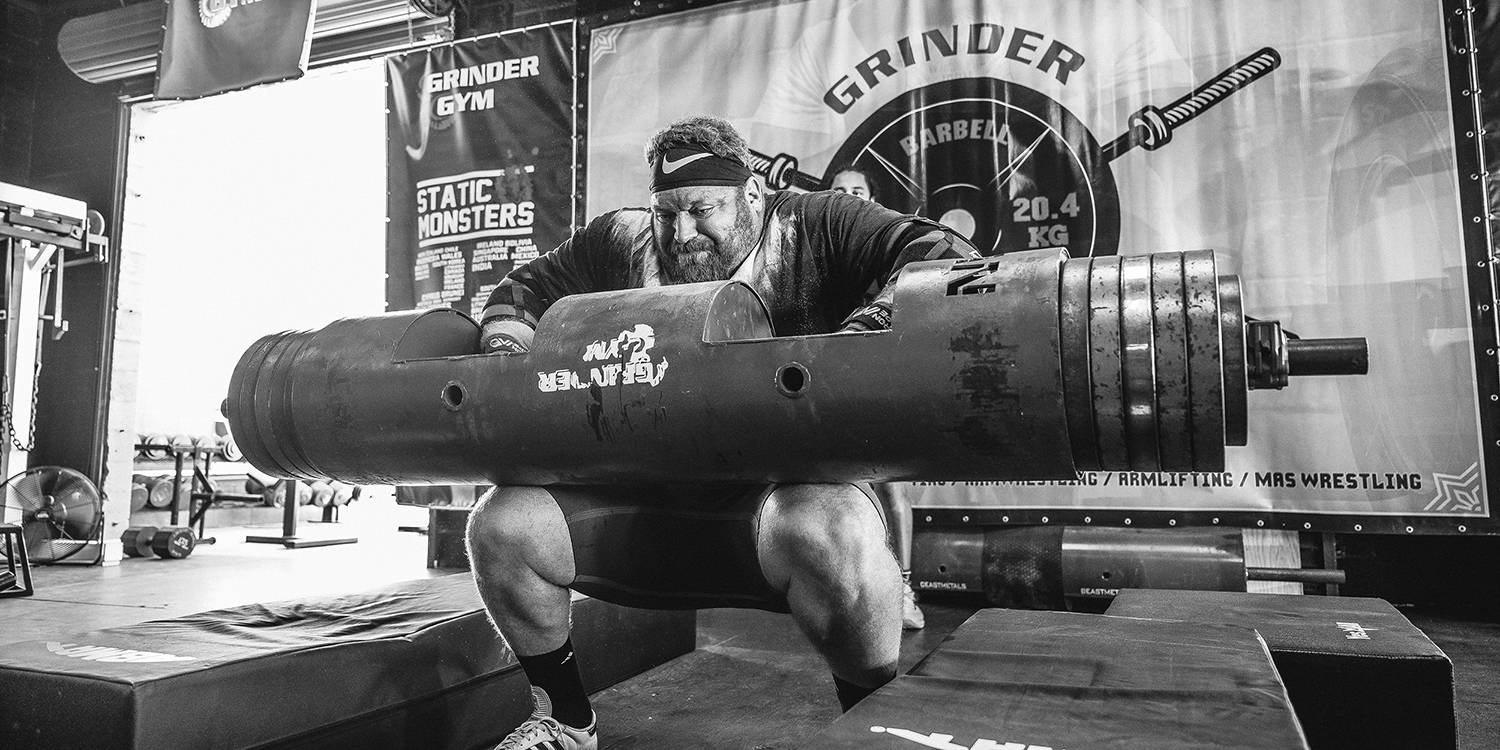
The log press is not a shoulder exercise.
It’s a full-body event disguised as an overhead lift.
If you treat it like a barbell strict press, you’ll stall. If you understand how to pick it, lap it, roll it, and drive it with your hips, you’ll start adding weight fast.
The difference between struggling with a log and dominating it usually isn’t raw strength. It’s efficiency.
Let’s break it down the way we teach it.
The Log Clean: Where the Lift Is Won
Most athletes lose the lift before they ever press it.
The clean determines everything.
1. The Setup
- Feet about shoulder-width
- Log slightly tilted forward
- Handles angled toward your hips
- Chest tall
- Brace hard
Think deadlift, not row.
If you start with your hips too low or try to muscle it up, you’ll waste energy immediately.
2. The Pick (Deadlift Style)
The log comes off the floor like a deadlift.
- Drive through your legs
- Keep it tight to your shins
- Don’t curl it
- Don’t yank it
It should travel close. The farther it drifts away, the heavier it becomes.
Strongman is about managing leverage. Distance equals difficulty.
3. The Lap (“The Sit”)
As the log reaches your knees:
- Sit back slightly
- Let it settle into your lap
- Stay braced
- Keep your back flat
This is your reset position.
You’re not pausing because you’re weak.
You’re pausing because you’re smart.
This is where you breathe, rebrace, and prepare for the roll.
4. The Roll to the Chest
This is where most lifters make the biggest mistake.
They try to curl the log.
Don’t.
From the lap:
- Flare elbows slightly
- Squeeze the log into your torso
- Explode your hips forward
- Roll it up the body
It’s a violent hip extension.
Think clean and pop — not curl and grind.
If your hips don’t drive, your press will suffer.
The Rack Position: Build a Platform
Once the log hits your chest, it must be secure.
Key points:
- Elbows high and forward
- Chest up
- Upper back tight
- Log resting against your body, not floating
If your elbows are down, you’ve already lost leverage.
You’re building a shelf. Not holding a weight in your hands.
The better the rack, the easier the press.
The Press: Leg Drive First
Now we press.
And this is where too many athletes rely on shoulders instead of legs.
Breathing & Bracing
- Big breath
- Core tight
- Lock everything in
The Dip & Drive
Whether you push press or jerk:
- Dip straight down
- Drive violently up
- Transfer power from hips to log
Push your hips through.
This is not a shoulder press. It’s a power transfer.
Press Path
Keep the log close.
- Push it up
- Move your head back slightly
- Drive through
- Snap your head through at lockout
Finish stacked:
- Log over shoulders
- Elbows locked
- Core braced
- Head through
Stability wins reps.
Common Log Press Errors
Let’s clean up the big ones.
Trying to Curl the Log
You’ll burn out your arms and stall the clean.
Letting the Log Drift Away
Every inch away from your body makes it feel 20 pounds heavier.
Weak Rack Position
Low elbows kill pressing power.
No Leg Drive
If you’re pressing it like a strict barbell, you’re limiting yourself.
Rushing the Clean
The lap is your advantage. Use it.
How to Train for a Bigger Log
Improving the log requires targeted work:
- Log cleans (skill)
- Push presses
- Jerk technique
- Heavy overhead supports
- Upper back work
- Triceps strength
- Core bracing drills
But here’s the truth:
Most people don’t need more strength.
They need better mechanics.
I’ve seen athletes add 20–40 pounds just from fixing their clean and rack.
Efficiency Matters in Competition
In competition, the log appears as:
- Max weight attempts
- Reps for time
- Press medleys
If your clean is inefficient, you’ll gas out before the pressing starts.
If your rack is weak, you’ll lose power before lockout.
The smoother your clean, the more energy you save for the reps that count.
Why This Is Hard to Learn Alone
The log feels different than anything in a commercial gym:
- Neutral handles
- Thick diameter
- Rolling clean
- Awkward balance
You can watch videos all day, but until you feel:
- the lap timing
- the hip extension
- the rack pressure
- the lockout stabilization
you’re guessing.
And guessing slows progress.
Train the Log the Right Way
If you want to truly improve your clean and press, you need:
- Real logs
- Real reps
- Real feedback
- Real coaching
Grinder Gym Strongman Workshops give you:
- Hands-on log instruction
- Technique correction in real time
- Proper event equipment
- Structured progression
- An environment built for strength
Whether you’re new to strongman or preparing for competition, the log press is a skill — and skills improve fastest in person.
Stop guessing.
Come train it correctly.
Join a Strongman Workshop at Grinder Gym and learn how to clean and press the log with power, efficiency, and confidence.
Comments are closed