
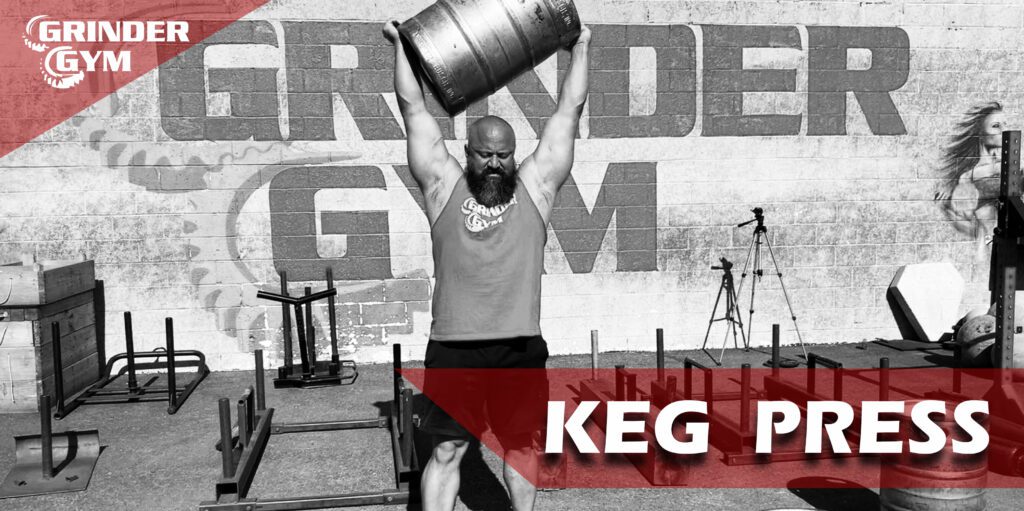
The Keg Press is a classic Strongman event that combines strength, stability, and coordination.
Athletes lift a large, weighted keg from the ground or platform, bring it to chest height, and press it overhead to full lockout.
The defining challenge of this event is the implement:
- Uneven weight distribution
- Shifting contents
- Awkward shape
This forces athletes to manage instability while producing force.
The Keg Press is not just about pressing strength. It is about controlling an unpredictable load.
Keg Press in Strongman Competition
The Keg Press is commonly used in multiple formats:
- Maximum load
- Repetitions for time
- As part of a medley
Each format tests a different quality:
- Max load → absolute strength
- Reps → strength endurance
- Medley → efficiency under fatigue
Event Description
The Keg Press involves:
- Lifting the keg from the ground or platform
- Stabilizing it at chest height
- Pressing it overhead to lockout
Because the load can shift during the movement, athletes must constantly adjust position and control throughout the lift.
Equipment Specifications
Keg
- Typically metal or heavy-duty plastic
- Filled with sand, water, or mixed materials
- Common weight range: 100–250+ lbs depending on division
Shape and Grip
- Cylindrical with rounded ends
- May have handles or be completely smooth
- Shifting contents increase difficulty
Loading Position
- Keg may start from the ground or an elevated platform
Rules and Execution
Objective
Press the keg overhead to full lockout for:
- Maximum weight
- Maximum repetitions
- Or within a time limit
Step-by-Step Execution
Setup
- Keg begins on the ground or platform
- Athlete establishes a stable base
Clean
- Grip the keg and bring it to chest height
- Stabilize against the body
- Control the shifting weight
Press
- Use leg drive and upper body strength
- Maintain control as the load shifts
- Press the keg overhead
Lockout
- Arms fully extended
- Keg stabilized overhead
- Wait for the judge’s command
Descent
- Lower the keg under control
- Return it safely to the ground or platform
Good Lift Criteria
A lift is successful when:
- Full lockout is achieved
- Arms are extended
- The keg is stabilized overhead
- The athlete demonstrates control
- The judge gives the signal
Common Reasons for a No Rep
- Failure to reach full lockout
- Loss of control overhead
- Failure to stabilize the keg
- Dropping the keg from overhead
- Failure to follow event rules
Equipment Rules
Allowed
- Chalk
Not Allowed
- Lifting straps
- Tacky
- Other grip-assisting aids
Primary Muscles Worked
The Keg Press develops:
- Shoulders and triceps for pressing strength
- Core for stability under shifting load
- Forearms and grip for control
- Legs and hips for power during the press
Why the Keg Press Matters
The Keg Press is a test of control as much as strength.
Unlike fixed implements, the keg:
- Moves
- Shifts
- Forces constant adjustment
Success depends on:
- Positioning
- Timing
- The ability to stay tight while the load changes
Training the Keg Press
The Keg Press can be developed through:
- Push press variations
- Overhead strength work
- Grip and carry training
- Stability training with uneven loads
Key focus areas:
- Efficient clean to conserve energy
- Strong leg drive during the press
- Maintaining control throughout the movement
Common Mistakes
- Poor control during the clean
- Letting the keg drift away from the body
- Underutilizing leg drive
- Excessive leaning back during the press
Variations and Alternatives
- Water-filled keg press for increased instability
- Single-arm keg press for unilateral control
- Log press or barbell press for general overhead strength
Scoring and Formats
The Keg Press may be run as:
- Maximum weight (1–3 attempts)
- Repetition event (fixed weight for time)
- Timed or medley-based event
History and Use in Strongman
The Keg Press comes from traditional strength challenges involving barrels and awkward objects.
Modern Strongman has standardized the implement while maintaining the core challenge:
- Managing unstable loads
- Demonstrating real-world strength
Real-World Carryover
The Keg Press reflects real-world demands such as:
- Lifting unstable objects
- Controlling uneven loads
- Adapting to shifting weight
Keg Press at Grinder Gym
The Keg Press is used at Grinder Gym in both training and competition.
It is most commonly programmed as:
- A repetition event
- Part of a press medley
Athletes train with:
- Competition-style implements
- Clear standards
- Structured progression
Train the Keg Press at Grinder Gym
If you want to improve at this event, you need:
- The right equipment
- The right structure
- The right coaching
At Grinder Gym, athletes train using competition-style setups and clear performance standards.
Comments are closed