
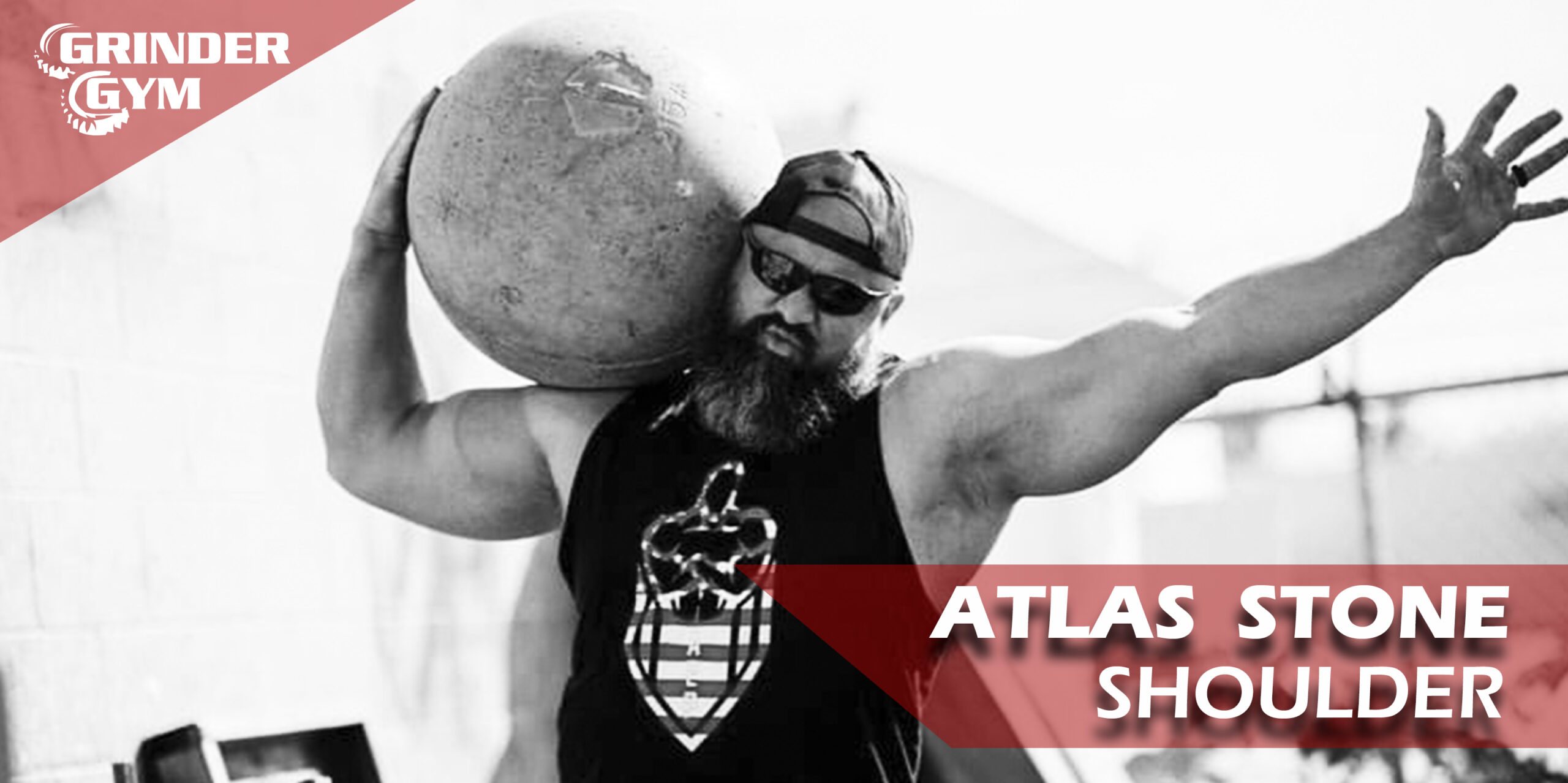
The Atlas Stone to Shoulder is a classic Strongman event that requires an athlete to lift a stone from the ground and place it onto one shoulder under control.
Unlike loading events, this variation demands:
- Precision
- Balance
- Control in a high position
It is not just about getting the stone up.
It is about owning the position once it is there.
Atlas Stone to Shoulder in Strongman Competition
This event is commonly performed as:
- Maximum weight
- Repetitions for time
- Timed hold or stabilization
Each format tests a different quality:
- Max weight → absolute strength
- Reps → efficiency and conditioning
- Hold → control and stability
Event Description
The athlete lifts a spherical Atlas stone from the ground, brings it to the lap, and transitions it onto one shoulder.
Once on the shoulder, the stone must be stabilized under control until the judge gives a command.
This event requires:
- Strong hips to elevate the stone
- A stable core to control it
- Precision to secure the final position
Equipment Specifications
Atlas Stones
- Concrete or steel spherical stones
- Typically range from 100 lbs to 400+ lbs
Stone Size
- Diameter increases with weight
- Larger stones increase difficulty due to grip limitations
Surface and Setup
- Flat lifting area
- Adequate space for safe loading and unloading
Equipment Rules
Allowed
- Chalk
- Tacky
- Belt
- Knee sleeves or wraps
- Elbow sleeves
- Forearm guards
Not Allowed
- Any equipment that artificially secures the stone beyond standard grip aids
Rules and Execution
Objective
Lift the stone to one shoulder and demonstrate control until the judge signals completion.
Step-by-Step Execution
Setup
- Position over the stone
- Feet shoulder-width apart
- Establish a strong grip and brace
Lift to Lap
- Pull the stone into the lap
- Reposition hands for the transition
Lift to Shoulder
- Extend through the hips
- Drive the stone upward
- Guide it onto one shoulder
Stabilize
- Control the stone on the shoulder
- Maintain balance and posture
- Do not rely on the opposite arm for support
Completion
- Wait for the judge’s command
- Lower or release the stone under control
Good Lift Criteria
A lift is successful when:
- The stone is fully secured on one shoulder
- The athlete demonstrates control and balance
- The stone remains stable without slipping
- The judge gives the signal
Common Reasons for a No Rep
- Failure to secure the stone on the shoulder
- Using the opposite arm to stabilize
- Loss of control before the judge’s command
- Allowing the stone to roll off prematurely
Why This Event Matters
The Atlas Stone to Shoulder tests a unique combination of qualities:
- Explosive strength
- Positional control
- Stability under load
It exposes weaknesses in:
- Bracing
- Coordination
- Confidence with awkward objects
Training the Atlas Stone to Shoulder
The event can be developed through:
- Atlas stone loading progressions
- Lap and extension drills
- Front-loaded carries
- Core stability work
Key focus areas:
- Efficient lap position
- Strong hip extension
- Controlled transition to the shoulder
- Staying tight in the final position
Common Mistakes
- Poor lap position leading to missed transitions
- Rushing the lift without control
- Leaning excessively to compensate for the load
- Failing to stabilize before the judge’s command
Variations and Alternatives
- Repetition stone to shoulder
- Heaviest stone to shoulder
- Alternating shoulders
- Sandbag to shoulder (for training progression)
Scoring and Formats
The Atlas Stone to Shoulder may be run as:
- Maximum weight
- Repetition event within a time limit
- Timed hold or stabilization
History and Use in Strongman
Stone lifting has been part of strength culture for centuries.
The shoulder variation reflects:
- Traditional stone carrying
- Real-world strength tasks
Modern Strongman has formalized this into a repeatable and judgeable event.
Real-World Carryover
This event develops:
- The ability to lift and control awkward objects
- Stability under uneven loading
- Full-body coordination
Atlas Stones at Grinder Gym
Atlas stones are a core part of training at Grinder Gym.
Athletes train with:
- Multiple stone weights
- Competition-style setups
- Progressive skill development
The Stone to Shoulder is used to build:
- Confidence
- Control
- Event-specific strength
Train the Atlas Stone to Shoulder at Grinder Gym
If you want to improve at this event, you need:
- The right equipment
- The right structure
- The right coaching
At Grinder Gym, athletes train using competition-style implements and clear performance standards.
Comments are closed